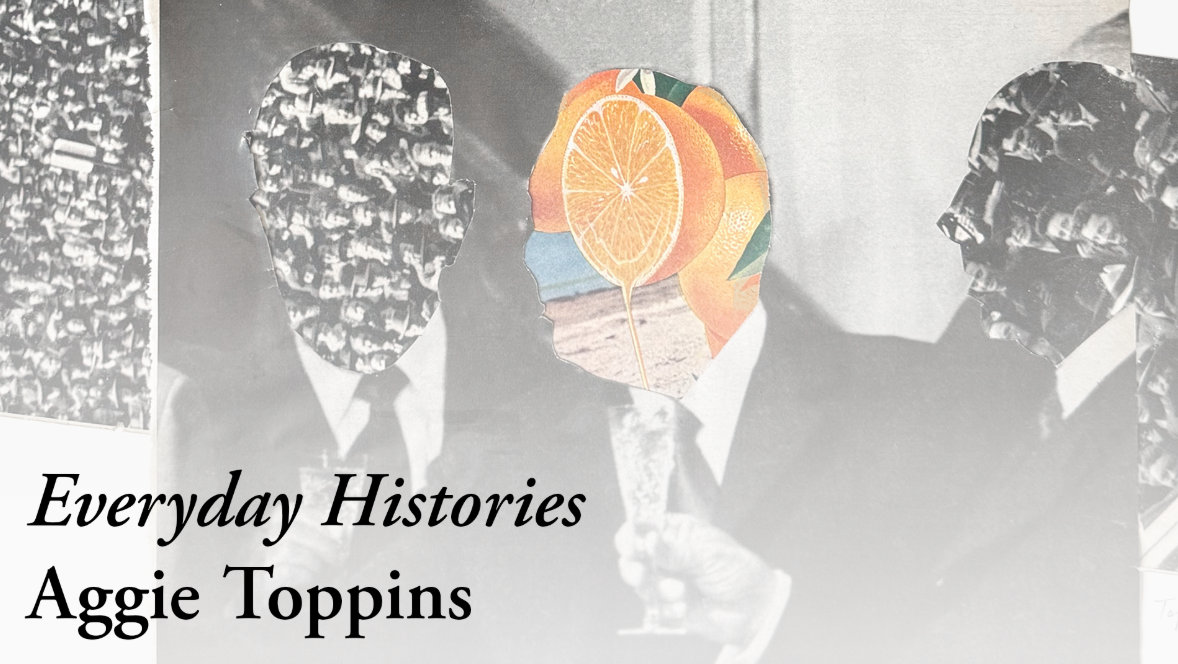
Everyday Histories by Aggie Toppins
Curated Gallery
June 12 - July 18, 2026
Artist Talk: June 12, 2026 | 6-6:30 pm
Opening Reception: June 12, 2026 | 6:30-8 pm
Aggie Toppins creates collage using materials found in archives, midcentury magazines, and daily life to index everyday experience and access the historical imagination. Toppins asks questions about how the past remains in the present, with a particular interest in gendered discourses of class. As a graphic designer by training, she is drawn to the polysemous potential of fragmentary forms. She combines her studio background with historical methods to position these fragments as primary sources. Upon revisiting, recombining, and reinterpreting these sources, she makes pictures that engage viewers in cognizant acts of translation.
Philosopher Gilles Deleuze saw the historical source as an assemblage, a composite of multiple contingent meanings. Sources bear witness to the idea that every moment in time inhabits, and is inhabited by, other times. Walter Benjamin similarly relayed thoughts about temporal conflation through his metaphor of the “dialectical” or “stand-still” image. Although Benjamin never fully developed this idea in his published writing, the stand-still image seems to represent a moment of arrest in which we the living suddenly recognize yesterday’s slain and silenced as the harbingers of our own political struggles. By collecting, arranging, and re-presenting extant cultural materials, Toppins hopes to figure something like a stand-still image. In making her work, she asks how much of a sign, and how many, are necessary to conjure this sort of recognition? To what extent does the collage image, which puts indeterminacy on display, invite multiple readings? In what ways can images deliver the idea that this moment is not one but several?
Everyday Histories is a recent body of work in which she explores three generations of family history. Toppins was raised almost entirely by women, many of whom have passed on, with roots in rural Ohio and the coal mines of West Virginia. Her grandmothers were born during the Great Depression and raised their children during the Cold War, an era marked by gains in civil rights as well as the threat of total annihilation. Yet they left behind little evidence that they ever existed. Through collage, she traces the contours of their being, contrasting the material and symbolic realities of their lives against visual evidence of the continuation of patriarchal power.
Predicated on resourcefulness, collage is a way of “making sense” by “making do,” something her grandmothers, in their poverty, knew much about. The sustained practice of this patchwork medium calls attention to the historical marginalization of women’s work. None of these images are meant to represent coherent narratives. Rather, they are like archaeological reconstructions, to borrow words from Melissa Meyer and Miriam Shapiro, that invite viewers to decipher as they sift through layers of time.